
Call this Wednesday to Get $35 OFF
Call this Wednesday to Get $35 OFF
Local Electricians in Virginia Beach, VA - We Are Family & Veteran Owned.
Call this Wednesday to Get $35 OFF
Call this Wednesday to Get $35 OFF
Local Electricians in Virginia Beach, VA - We Are Family & Veteran Owned.

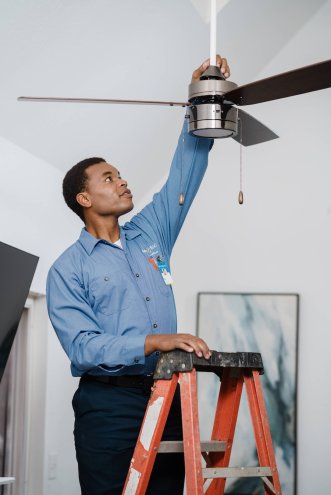
Ceiling fan replacement looks simple enough that plenty of homeowners grab a ladder and start unscrewing things. Then the problems begin. At Mr. Electric, we get calls from people mid-project who realized the wiring doesn't match, the box won't hold the weight, or the new fan wobbles no matter what they try. Some mistakes are frustrating, but others create safety hazards. The good news is that most of these errors are completely avoidable once you know what to watch for. We're walking through the most common missteps so you can decide whether this is really a DIY job or one worth handing off to a professional.
Standard light fixture boxes are rated for 15 to 25 pounds. A ceiling fan with blades and a light kit weighs 30 to 50 pounds on average. The math doesn't work. Ceiling fans also generate rotational torque that pulls against the mounting hardware with every rotation. The constant motion stresses connections. A plastic box designed for a simple pendant or flush mount will crack, loosen from the joist, or pull free entirely. The result ranges from an annoying wobble to the entire fan crashing down onto furniture, flooring, or anyone standing below. Before you install anything, check the box rating stamped inside the existing fixture housing. You need a metal box rated for ceiling fan support or a fan brace bar that spans between joists and anchors securely to the framing. Installing the correct box takes about 20 minutes with attic access. Replacing a fan that fell through your ceiling costs much more in time, money, and drywall repair.
Wire colors communicate function, but older homes don't always follow modern conventions. Black typically means hot, white means neutral, and green or bare copper serves as ground. The problem is that ceiling fans have their own wiring scheme that doesn't match a simple light fixture. You'll find black for the motor, blue for the light kit, white for neutral, and green for ground. That's four wires on the fan side. If your ceiling junction box only has two wires plus ground, you won't be able to control the fan and light independently without running new cable or installing a remote system. Some homeowners connect the blue and black fan wires together to the single hot wire in the ceiling. This works but eliminates separate control of the fan speed and light brightness. Others cap off wires incorrectly or connect hot to neutral by accident. Wrong connections trip breakers, blow fuses, damage the fan motor, or create fire risks inside the junction box. Older homes are even more challenging because previous owners may have run wires in nonstandard configurations. When the existing wiring doesn't match any diagram in the fan manual, that's a sign you need a professional electrical service.
Flipping the wall switch to the off position doesn't guarantee the wires are dead. Switches control the hot wire, but a miswired circuit might leave power running through neutral or have multiple hot lines feeding the junction box from different directions. Electricians in Grafton, VA test with voltage meters before touching anything. Homeowners assume the switch handles it, but this assumption causes electrical shocks, burns, and in serious cases, electrocution. The correct procedure starts at your breaker panel. Turn off the circuit that controls the fan location and verify it's off by testing the switch. Then use a voltage tester that detects power without touching wires. Touch the tester to each wire individually. If you find power where you didn't expect it, stop immediately. That indicates a wiring issue beyond a basic ceiling fan replacement and requires someone qualified to trace the circuit and identify where the extra power originates. Working with electricity demands respect for the invisible hazard it presents. You can't see or smell voltage. You can only test for it with the right equipment and the right habits. Skipping this step puts your safety at risk every single time, despite how simple the project appears.
Aluminum wiring requires special connectors and techniques because it expands and contracts differently from copper. Standard wire nuts create loose connections and can arc or overheat. Knob and tube systems in older homes have no ground wire and may not safely support modern fixtures without upgrades. If your ceiling box sits in a location with no joist access from above, installing a proper fan brace becomes a major project that involves cutting drywall and working in confined spaces. Flickering lights, buzzing sounds, or warm switch plates all indicate underlying issues that a simple fan swap won't fix. Those symptoms point to circuit problems, loose connections somewhere upstream, or undersized wiring that can't handle the electrical load. Calling qualified electricians before you start prevents disasters midway through the job. They'll determine whether your existing wiring can support the fan, install the correct box if needed, and verify the circuit handles the load without tripping breakers or overheating. This work falls under standard electrical service and typically costs less than repairing damage from a failed DIY attempt. A cracked ceiling, a burned junction box, or a damaged fan motor all add up fast. Ceiling fan replacement moves faster and ends better when you recognize your limits and act on them before problems develop.
A new ceiling fan improves air circulation, cuts energy costs, and adds comfort to a room. But the installation has to happen correctly for those benefits to last. Taking time to evaluate your setup before you start saves hours of frustration and prevents hazards. Call Mr. Electric. Our technicians install ceiling fans safely, verify your electrical system meets current code, and confirm everything operates exactly as the manufacturer intended. Contact us to schedule your ceiling fan installation and get the job done right the first time.
 14Jan
14Jan
Ceiling fan replacement looks simple enough that plenty of homeowners grab a ladder and…
Read More 07Jan
07Jan
One lightning strike or power surge can wipe out thousands of dollars in electronics…
Read More 05Jan
05Jan
Smart home devices promise convenience, but the reality rarely matches the box. At Mr.…
Read More 28Dec
28Dec
Thousands of homeowners end up in the emergency room every year because of generators.…
Read More